
Delicious Mushroom is Invasive, Disruptive For Iowa, Illinois, and Wisconsin
I’ve made no secret of how much I love golden oyster mushrooms. Their nutty flavor, vibrant yellow caps, and how easy they are to find (especially compared to those elusive morels) made me fall back in love with mushroom hunting after many years of frustration.

My Son, Bennett, with one of his Golden Oyster Mushroom hauls.
These bright fungi turned my everyday hikes into treasure hunts and made it feel like nature was finally sharing something tasty and abundant with me. But recently, I learned that these golden beauties aren’t just friendly forest guests. They're invasive.
The golden oyster mushroom (Pleurotus citrinopileatus), native to eastern Asia, has been spreading rapidly across North America, including right here in Iowa, as well as Illinois and Wisconsin. First introduced via grow kits and commercial farms in the early 2000s, they’ve now naturalized and are popping up all over, especially on dead hardwoods like elm. While I was celebrating a hefty haul from White Water Canyon, researchers were sounding the alarm: these mushrooms are muscling out native fungi.

A study out of the University of Wisconsin–Madison and the U.S. Forest Service found that trees colonized by golden oysters hosted only about half the fungal diversity as those without them. That’s a big deal, since our native fungi are critical for breaking down wood, cycling nutrients, storing carbon, and even helping trees absorb water through root symbiosis. In other words, the entire forest floor's health depends on a diverse fungal network, and researchers say those delicious golden oysters are upsetting the balance.

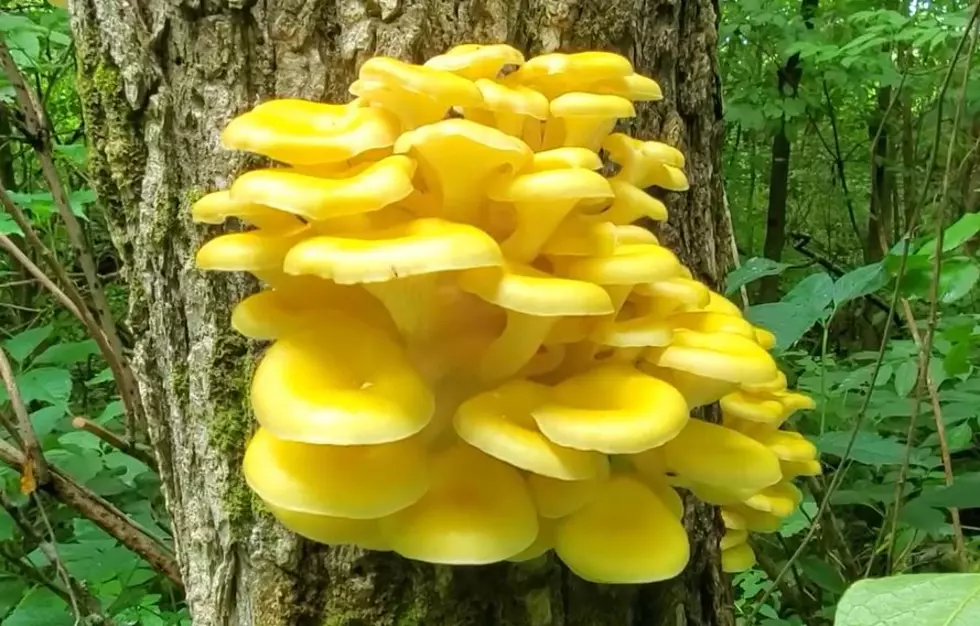
Golden Oyster Mushrooms and how they grow. Photo taken at Eden Valley on one of my family's hikes.
Further research by Andrea Bruce in 2018 showed that wild golden oyster populations in the U.S. likely stem from multiple introductions via cultivation. Genomic analysis confirmed that these mushrooms didn't just escape from one place; they’ve been released (intentionally or not) in many places, and now they’re thriving.
Containment? Honestly, it’s probably too late. They’ve been documented in at least 25 states and one Canadian province, and recent changes in temperature and moisture continue to help them spread even further. That means we may need to rethink how and where we cultivate them. Indoor growing only? Sporeless strains? Public education? It may help slow the spread, but it's unlikely that anything will stop it.
READ MORE: Iowa’s Best Mushroom to Forage Is NOT the Morel
So, I’ll admit. I’m a bit torn. I still love finding and cooking golden oysters. They got me back into the woods, and they’re undeniably tasty. But now, I’m also looking at them a little differently. These mushrooms may be delicious, but they’re not harmless.
As foragers and growers, we need to be aware of the bigger picture: sometimes what seems like a gift from nature turns out to be a disruptor in disguise. Either way, I'm going to keep harvesting them. Better in my belly than spreading through our forests, apparently.
Photos: Eden Valley Refuge
Gallery Credit: Tom Ehlers
Wisconsin Dells: Upper Dells Tour
Gallery Credit: Tom Ehlers
More From Eagle 102.3